

Blog:
JA Network Profile: The Breaking News Network explores new ways of expressing media


Started in 2009, the Breaking News Network curates the media and blog feeds in 350-plus cities worldwide to create a real-time ticker tape of social-media-sourced news in each city. The noncommercial network is unique in supporting each city’s civic groups, arts organizations and causes by providing them with a free media voice to connect with their community.

The JA had the opportunity to participate in the recent Street Fight Summit in New York City. While there, Breaking News Network (BNN) founder Patrick Kitano introduced himself.
When BNN was launched three years ago to give voice to community causes, Kitano brought a unique knowledge from early experiments using Twitter (2006 – 2009) and social media to develop hyperlocal community information networks for the real estate market. Focusing on social at the outset, Kitano was “cobbling together” segmented lists on Twitter before Twitter had even created “lists.” (For context, Twitter launched in July of 2006.) This early social community development revealed new ways that Kitano found effectively enabled an active, community-sourced and locally driven information network.
Kitano sees BNN providing a shared social channel – one community, one voice, one cause at a time – with promise of doing good for others by supporting civic groups, local causes and arts organizations.
Focused on public good
Three years, 300-plus cities with localized Twitter feeds, with a combined network of 400,000. Animating the concept behind the Breaking News Network, Patrick Kitano sees this as just the beginning. Building BNN to serve as a kind of “PBS of social media sourced news,” Kitano, who built the network out of a methodology developed for the real estate industry, has an unusually deep understanding of engagement using social media.

Patrick Kitano is a founder of Brand into Media where he works with corporations and organizations to develop brand-advocacy strategies focused on hyperlocal engagement. He started the Breaking News Network in 2009 as a project to build a local media network devoted to community service freed from the trappings of traditional advertising models. Working across media markets, Kitano has been an early adopter and trainer in social media applications, as well as the winner of the real estate technology Inman’s Innovator Award in 2009 for most innovative media.
His career began with selling local radio in San Francisco; from there he spent eight years working as an investment banker focused on the Internet and new media. Kitano then jumped in the market as an Internet entrepreneur with a focus on real estate, opening two businesses from 2003 – 2009. Kitano describes the second real estate business, a social media consulting firm, as a “first to market” real estate technology blog. He immediately recognized and began to tap into the power of Twitter to reframe the traditional realtor sales tack of hard sell to connect with the community in a helpful way that did not include banner ads or push marketing.
The constant throughout all of this, Kitano explains, is “finding new ways of expressing media.”
Take inventory
“Brand advocacy works where people know each other at a very local level.” In 2009, Kitano began to see new possibilities emerging as an early power user of Twitter and social channels to connect communities at the hyperlocal level. For the Breaking News Network, currently established as an LLC, the aim is to channel the hyperlocal network development from Kitano’s early realtor social brand marketing success to a model of cross-community social connections where causes or information sources who hold expertise in the local culture offer content with a goal to “help others out.” Kitano has a lot of expertise from training veteran realtors to completely reorient their sales process; “If you can help causes out,” he says, “you can get involved in the community, where you can create a more beneficial base. “
BNN is broken into “20 categories around subjects such as sports, foodies, family, health, home & garden.” With “320 twitter feeds, all heavily localized, we do not auto-follow, but we do follow locals. About 50 percent of our Twitter feed followers are local,” explains Kitano, who aspires for BNN to function as a kind of “PBS of social media sourced news, no banner ads; it has never been our intention to have any commercials on it. It was going to promote the kinds of groups – civic groups, arts organizations, good causes – we want … to have a voice inside the network across 350 different cities, with a potential reach of 400,000.”
Give community a voice
In the conversation with Kitano, my line of questioning kept returning to profitability, trying to decode if and where the revenue model was. Kitano sees this piece differently as it relates to relationships with news media. He thinks “media ideally should be a utility to connect the community by allowing anybody to get their word out using social media. Then local media becomes more sustainable by expanding the number of participants beyond those who can pay for play. As a content model, I think the curated community bulletin board is more efficient and real time, and less costly than the traditional editor-submission model.”
For Kitano’s social public service channel, this bulletin board concept for BNN evolved “because every time a new partner came up that allowed us to deliver or present the news better, it just made our jobs easy to do these things simply. Curating media feeds through dlvr.it, Facebook and Twitter, onto the rebel mouse platform – creating a panorama of things to do, anything you want to do in a city, GroupTweet gives us the ability to take anyone inside the community and RT them with a hashtag. If we can give them a voice, and we authorize them, we’re able to create in essence a kind of bulletin board across our 350 cities. BreakingSFNews is our workshop.”
Got social equity?
For Kitano, authentic and trusted voices in the community that share breaking news through a common channel, segmented on a very local level with 320 Twitter feeds, represents a powerful model for delivering relationship-driven brand advocacy. As an example, BNN has been working closely with the Do Something Good project, a national nonprofit that empowers young people to participate in social change campaigns. In their current campaign Teens for Jeans BNN is able to “publicize at a local level [larger national ] campaigns. We are creating a brand-advocate network where lots of the teens … have Twitter accounts, [and] we reach out and directly connect with them. Offering to put a localized hashtag on their post, BNN broadcasts this out across their local community with a tag or identifier that associates them with a particular hashtag or effort. [We see this as a] model to develop campaigns, educate around the power of retweet (RT) explaining how to RT, so they pick up additional advocacy bound to a very local level.”
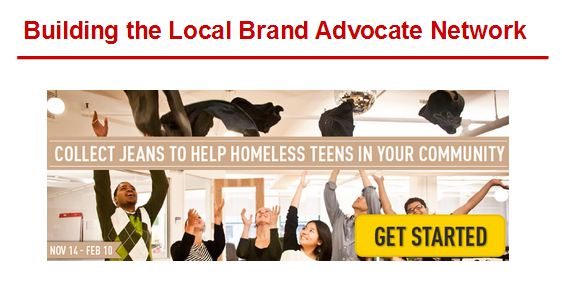
Teens for Jeans
As the conversation with Kitano unfolded, it revealed a fascinating way to think about local news providers and the existing opportunity to curate and cultivate communities around the local culture, providing a space for active, trusted opinion leaders who have a stake in the local information ecosystem. A softer aspect of sustainability, still in its infancy for standardized measurement and monitoring, is the growing importance of “Relationship Science” type products. As this new kind of intelligence raises the bar for social networking, brand loyalty and building consumer trust, could news channels tap into existing connections in the community to give the locals even greater utility?
What kinds of additional equity might publishers generate through existing Twitter community lists? Would it be worth exploring how breaking Twitter lists down into specific feeds you could control, might give your community greater reach, enhance their ability to connect with your content and ultimately, help build your business?



Weigh In: Remember to refresh often to see latest comments!
22 comments so far.
-
 Pat Kitano says:
May 22, 2013 at 1:55 pm
-
 Pat Kitano says:
April 8, 2013 at 10:01 am
-
 Pat Kitano says:
April 8, 2013 at 9:34 am
-
 Pat Kitano says:
April 8, 2013 at 9:37 am
-
 Pat Kitano says:
April 2, 2013 at 10:56 pm
-
 Pat Kitano says:
March 26, 2013 at 8:19 pm
-
 Lisa Skube says:
March 27, 2013 at 10:31 am
-
 Pat Kitano says:
March 27, 2013 at 11:55 am
-
 Pat Kitano says:
March 27, 2013 at 11:58 am
-
 Dean M Gray says:
March 27, 2013 at 4:35 pm
-
 Pat Kitano says:
March 27, 2013 at 4:49 pm
-
 Dean M Gray says:
March 28, 2013 at 4:41 pm
-
 Lisa Skube says:
March 28, 2013 at 6:17 pm
-
 Dean M Gray says:
March 11, 2013 at 6:22 pm
-
 Anthony Longo says:
February 27, 2013 at 4:00 am
-
 FlyersUp! says:
February 26, 2013 at 1:21 pm
-
 Pat Kitano says:
February 26, 2013 at 2:55 pm
-
 Lisa Skube says:
February 26, 2013 at 3:20 pm
-
 Christopher Sailus says:
February 26, 2013 at 11:34 am
-
 Lisa Skube says:
February 26, 2013 at 3:28 pm
-
 Pat Kitano says:
February 24, 2013 at 8:53 am
-
 Marian S. Bennett says:
February 23, 2013 at 9:30 am
| ParticipantsUpdate:
One of the roles The BreakingNews Network is to be a clearing house for news services that need to reach local audiences.
Local news isn’t just reported by the local press. For example, compelling local stories appear in news services like Colorlines.com, PublicNewsService.org and InvestigativeNewsNetwork.org that are intended for their national readers — but may not reach the local readership where it has the most immediate impact. By necessity, news services need to cater and appeal to the broader national readership in order to achieve the traffic required for monetization. The hurdle is developing and maintaining the syndication channels that get investigative news reports in Cincinnati to Cincinnati readers. I’m betting very few consumers recognize the networks named above, one reason is simply their brands are not distributed to local levels.
So we’ve been working together with The Media Consortium and Investigative News Network, with 63 and 83 news services respectively, to amplify their news services’ stories down to the local level. By continuing to add news services, we aspire to be the most comprehensive source for local news in the 350 cities we’re covering
Update:
Speaking of getting journalism students media access to their communities, we’re also providing media voice to the teens at DoSomething.org so they can promote their local cause campaigns. Our press release is up at http://thebreakingnewsnetwork.com/2013/04/02/building-a-national-advocate-media-network-with-dosomething-org/.
The unique feature of our work with DoSomething is in the building of local advocate networks. Teens generally aren’t old enough to have extensive local media contacts, so we want to give DoSomething’s advocates a voice for their 4,000 clubs nationwide.
At Journalism That Matters conference at the University of Denver this week, one of our missions was to support the journalism of inclusion: how to get more youth and minorities easy and instant access to media distribution. We believe journalism education’s role is to support the massive expansion of a citizen journalist class that will be far more prolific and closer to the news than what exists today in the fourth estate.
Thursday morning, a group of University of Denver journalism students attended the conference. We immediately offered them access to our Media Amplification Program so they can use Twitter to distribute their community news stories to over 12,000 followers of our 14 Denver area Twitter feeds.
We believe giving students the power of media access creates engagement; with our Media Amplification Program, students now can interact with 12,000 readers in their community and get real time feedback no classroom can provide. And with the assistance and oversight of their instructors, this facility makes their study of journalism instantly practical.
We have the full blog post up at http://thebreakingnewsnetwork.com/2013/04/05/the-journalism-of-inclusion-giving-youth-instant-local-media-access/
Update:
We’re now getting local TV newscasters and journalists to add city hashtags to their best community tweets so we retweet them in real time. Why TV? Newscasters are visible hubs of our communities, they often lend their crowd appeal to events and causes. They thrive on social media presence (think of it as ratings), and appreciate the service: http://thebreakingnewsnetwork.com/2013/03/20/local-media-let-us-help-promote-your-best-content/
Update:
We’ve got local politics covered in 47 cities and adding more. Most of our politicians are on Twitter to broadcast information to their constituency (NBC News says almost all of Congress are on Twitter). We’ve instructed the mayors, and city council members that when they tweet with the city hashtag (see them all at http://bit.ly/bnncities), we post/retweet them in real time on our respective city Twitter feeds. For example, when Mayor Ed Lee of San Francisco tweets with our #SF hashtag (https://twitter.com/mayoredlee/status/315670792459399169), our corresponding Twitter feed @breakingsfnews retweets the tweet instantly and automatically: (https://twitter.com/breakingsfnews/status/315670795873574913)
Making sure our politicians’ voices are heard locally is a key mission of The Breaking News Network.
Fantastic new feature Patrick, related to this, we just tweeted a great piece “Longer than the 10 commandments, shorter than the NFL rulebook: 22 rules for journalists” (http://bit.ly/YTWR0L) – from veteran Robert Mann. Useful for teachers, journalists, community groups covering a local beat, advocates or others involved in covering a political beat (for the “electeds” OR non-electeds – equally useful!) — another piece Mann wrote is a practical read titled “Press abuse: 15 simple rules for politicians and their flacks” (http://bit.ly/10ixZ4S) – more of a guide for press personal to engage with journalists with a baseline mutual respect and interest in what the other guy (or gal) has to say, the context they have behind it, and the perspective (or questions) they bring to critically important civic dialogue. Having the ability to interact in this way, animates conversation and draws community in vs. repels community.
Patrick – do you think city government could throttle local community discussion through BNN twitter feeds or do you see this more as a broadcast channel? It would be really interesting to see if BNN could spark community feedback and exchange with local leaders.
The ideal hyperlocal media model needs to behave more like a utility that can be accessible from top to bottom by a community. The traditional model is set up as an editorial gateway where commentary is steered through the publisher lens. What Twitter does for civic engagement is to create direct channels from politicians to constituency (in fact, I’ve always thought Twitter could be the foundation for this local media utility: http://streetfightmag.com/2012/07/09/using-twitter-as-a-hyperlocal-media-utility). To answer your question, politicians simply cannot throttle conversations when their constituents can access them more easily.
Local publishers still don’t recognize that tweets from the Mayor and city council are legitimate content sources that can be compelling breaking news when reproduced on a webpage like http://breakingsfnews.com/sf-politics/. Local news reporting should be about efficiency, reporters don’t need to write updates about City Hall doings when the Mayor is already broadcasting the same information.
Since we opened up our Community Retweet Program to politicians nationally, we can see they use Twitter as a PR platform by choosing which tweets to broadcast, very much in line with what Robert Mann counsels them to do in his rulebook. Now it’s easier for journalists to probe and clarify their pronouncements by Twitter as well (and yes, we are now adding local newscasters this week to our Community Retweet Program so they can ask these questions if they so choose http://thebreakingnewsnetwork.com/2013/03/20/local-media-let-us-help-promote-your-best-content/ )
I’m a little worried about the comment “reporters don’t need to write updates about City Hall doings when the Mayor is already broadcasting the same information.” especially when watching City Hall and the Mayor lie and deceive. In the perfect world, maybe. But the world is imprefect and City Hall doings are subjective and the Mayor has a political agenda. There is no such thing as the “same information.” It is unreasonable and troubling to allow the tyrany of city hall and the mayor to dictate news. To often, there are few altruistic motives when millions of dollars are at stake. In fact, the more I think about it the more I am convinced that reporters DO need to write updates about City Hall doings when the Mayor is broadcasting or the city manager making politics… http://www.desertvortex.com/2013/03/23/city-manager-launches-third-personal-website/
Good point Dean, I was a bit loose implying that a lot of the mundane reporting that reporters once did can now be offloaded to the sources themselves. Lisa Skube referenced Robert Mann’s 22 rules for journalists and first three are:
1. Journalism is an attempt to discern the truth from liars. Don’t expect anyone to tell you the truth. They won’t. It’s up to you to find it. Look for contradictions in what people say. Three words to live by: compare and contrast.
2. Most lies are those of omission. Most people aren’t going to lie totally. They’re just going to tell you the version of the truth that makes them look good.
3. There’s a big difference between repeating and reporting. Repeating what someone said is easy. It doesn’t require much judgment or intelligence. Reporting is a search for the best version of the truth. It requires intelligence, skepticism, hard work and lots of digging. Strive to be a reporter.
uhhhhhhhhhh I am at a loss here. Where I live politicians have all the money, all time, all the personnel and the will to dominate the media. Maybe the rest of the world is a rose palace of contment, without fault or error. Maybe it is because I am not a kid anymore. Maybe I been burned by too may lying politicians with resources out of my reach. I was hoping that BNN would help level the playing field. Honestly. Instead it really worries me that the BNN is advertising “Making sure our politicians’ voices are heard locally as a key mission of The Breaking News Network.” From where I live breaking news is reported independently, and often contrasts the public relations broadcast by the “politicians.” Crossing the line to serve as cheerleaders for politicians is not helping journalism or investigative reporting. Am I alone in seeing this as a problem? I’m am losing confidence that we are working for the same objectives when I hear that BNN is working to give a voice to the “politicians.” They have a voice and it is a bully pulpit to keep tell us what they want us to hear. Not necessarily what is true and right. Is that the purpose of BNN? Is that the public good?
Good questions and tension in the discussion! The way I have come to understand and hear Patrick focusing BNN Dean is simply a useful conduit (network) for those working to get their message out into their community, the ability to do so, with some nice additional capabilities Patrick and his crew are working on incrementally. Bending the power of Twitter to enable a community channel where others already are. To this point, when we were doing requirements gathering for JA, one of the key pieces of feedback the Seattle media community shared with us (where we piloted the JA project and did multiple focus group gatherings with media makers across the Northwest) — we learned one of the greatest values the media community saw they needed from a network, was that everyone “be there.” The utility the community identified was it provided in aggregate the ability to reach those in a specific community through a single channel, and through that they found a high degree of efficiency and sanity, in a world exploding with social platforms, news communities can become silo’d simply due to a lack of hours in the day and ability to “hit all the channels” where your audience “might be.”
Desert Vortex News would like to be #351 on the BNN
Kitano is definitely on to something with BNN. I also caught up with him at the NYC SF conference and we shared in a conversation regarding the aggregation of social content on a hyper-local level (what BlockAvenue is doing), however, I think an aggregation via lists or services like BNN on any topic adds value to “that” community (be it around a location or interest or topic). Keep at it, this is the future.
Gotta echo Chris’s sentiment here. With TBNN, Pat has a unique structural vision for the future of local news distribution and how to combine emerging tools with human capital. He’s built a nationwide grass roots media network on web backbone at a fraction of the cost–essentially no cost–of top-heavy products like Patch and Nextdoor. Instead of a sanitized walled-in space and 9 figure price tag, it’s an open, bustling farmers market, arts cafe and dojo where everyone can participate. Pat’s civic focus makes TBNN a perfect channel to reach the engaged community members who benefit most from access to our activity feeds.
We immediately saw the fit for FlyersUp! and our native social media content syndication engine. By partnering, our technology makes local distribution of sustainability, arts, food and wellness events and classes as simple as posting a flyer on a local food market’s bulletin board. It’s a direct visual approach that draws a natural community of real people and activities that are “part of the solution.” Thanks Lisa for the insight!
FlyersUp’s service is a good example of how the publishing flyers of local events can be just as important to community readers as any other news. You can see an example of how the BNN publishes flyers (eventually across 350 cities) at http://hawaiibreakingnews.com/flyersup.
One of the missions of the BNN is to curate the content the community creates. We publish the Hawaii flyers uploaded onto FlyersUp automatically in real time. We solve the bottleneck for organizations who have to submit their press releases or flyers each time to a local media organ, and wait for an editor to approve it. Now it’s upload and done.
One of our business models is to support companies that offer collaborative ways of working and connecting within local communities by providing our locally respected gateways into each city. For example, we automatically share great neighborhood info provided by our partners BlockAvenue.com in the cities they want to develop through our Community Retweet Program (http://bit.ly/BNNrt)
Really great to see a conversation spark here, digging in to this idea of a new way to get out your “PSA.” In recent years the ability it seems for so many groups, specifically nonprofit organizations and civic causes, to figure out HOW to get their news out to their larger “local” community has been disrupted, if not even more so, than the traditional legacy news model. It seems that BNN is one of the more interesting and innovative ways to begin to close this gap for local communities. An additional resource to tap into, or collaborate with, at the neighborhood level is the National Neighborhood Indicators Partnership – the thing that makes BNN so potentially powerful is the grassroots as its foundation, and the fact it is so useful and simple!
Lisa, what drew me to get involved with BNN two years ago was realizing how inexpensive & effective Pat’s concept is to gather and curate local content. We have created a hyperlocal network that is just as informative, and maybe more participative as Patch, and spent almost nothing to do it. Compare that with the $150 milliion/year that Patch dropped, it’s pretty dramatic.
Chris thanks for taking the time to share your experience with BNN. It’s interesting how even in participatory news sites folks continue to talk past one another, rather than engage in a conversation WITH one another. With the hyperlocal network you’ve created, what kinds of local participation have you inspired, and what additional things do you hope to inspire through your network? Is the information focused around investment tips and news or is it more aligned with the local community there, spanning topics that are useful to them? Could you share the link to your network so others can check it out?
Thanks Lisa for a comprehensive review of the evolution of The Breaking News Network. Your analysis boils down to a simple conclusion I’ll make here in the comments (I provide links at http://bit.ly/jaBNN)
Curation of the community is more than just local news, it’s curation of the content the community creates. We’re focused on promoting the civic institutions creating content that enriches lives, so one of our projects is to expose the real time activities of museums, performing arts and the local politicians. (We’re big Rebelmouse fans because we use their visual Pinterest-style display platform that enhances the artistic nature of these organizations). We also aim to bring the messages of national causes like DoSomething.org down to the local level by amplifying their local advocacy in every city.
We cherish the idea that these civic institutions don’t need to do anything to get their message across the community using social media, we just set them up once to run and it broadcasts automatically. It’s far more efficient than the editor submission model that requires continual updating to local publishers.
So glad to see someone has taken notice of this innovative approach to media. I’ve been involved in this network since its inception. I am looking forward to using BNN to help our local non-profits, particularly the one I’m involved with @sonrisascdc!